Laurel, MD · Garage Door Service
Laurel Garage Door Pros travels 15 miles from Laurel to Crownsville, MD for garage door repair, spring replacement, and opener service on 1980s-era homes.
Crownsville is about 15 miles out from our Laurel shop, past the closer stops like West Laurel and North Laurel on the way down. That distance matters for how we schedule - we don't have a crew or a depot sitting in Crownsville, so every job here gets built into a truck's route for the day rather than promised as a drop-in visit. If you call in the morning, we're working out where Crownsville fits against the other stops already on the board, not guessing at an arrival window. We'd rather tell you that up front than pretend we're around the corner. The upside of the drive is that we're not rushing the job to get back across town - once the truck is out this far, the tech has the time budgeted to do the repair right instead of watching the clock. Have your driveway or a clear spot near the door ready; with the extra mileage, we don't want a second trip out here because a ladder couldn't get placed.
We don't do new construction framing - if the rough opening for your garage isn't already built, that's a carpenter's job before it's ours. We also don't fabricate custom wood doors from scratch; we install manufacturer units, and if you're set on a hand-built wood door, that's a specialty shop's work, not ours. Specialty glass-panel inserts and some higher-end insulated models are special orders through the manufacturer, and lead times on those can run a couple of weeks - we'll tell you that number when we quote it rather than guess low. And if a door's been neglected long enough that the frame itself is rotted or racked out of square, patching the door won't fix the real problem; at that point you're looking at carpentry first. We say this upfront because a garage door company that claims it can do everything usually means it does most things poorly. Better to send you to the right trade for the framing and come back for the door once that part's solid.
Crownsville's housing runs newer than what we see closer to Laurel. The median build year out here lands around 1986, well past the 1960s-70s stock that makes up most of the wider service area and the 1974 median across the region as a whole. That gap of roughly a decade or more matters - it means fewer of the original steel doors and first-generation openers that Laurel's older sections still carry. With around 586 households in this area, it's a smaller, tighter cluster than the denser parts of the service territory, and household income here runs noticeably higher, at $146,486 versus $117,270 across the broader area. That income level tends to track with more owners who've already upgraded to insulated steel or composite doors rather than living with whatever came from the builder forty years ago. It doesn't mean nothing breaks - springs wear out on any house regardless of the tax bracket - but the failure patterns we see skirt more toward worn rollers and aging openers than the rusted-through panels and obsolete torsion hardware common on older stock.
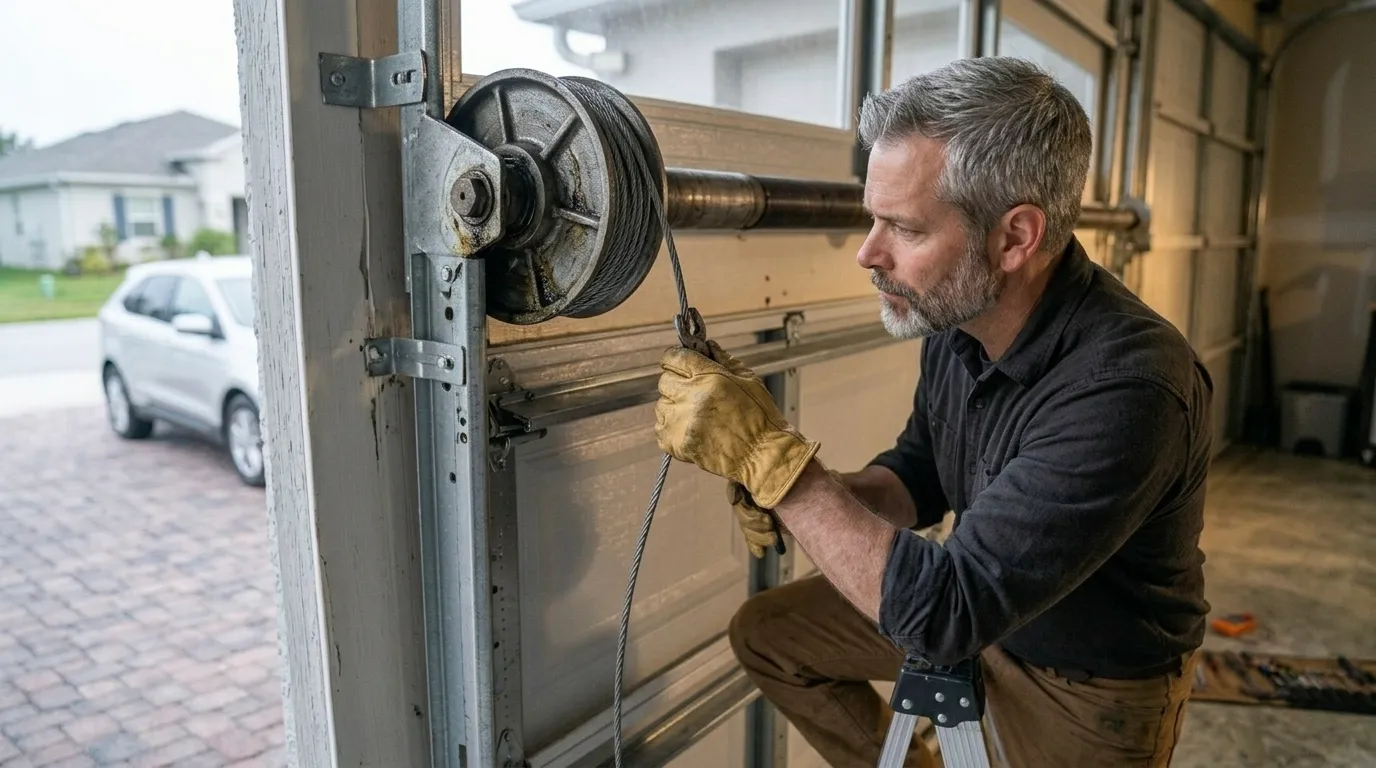
A door installed around 1986 is usually on an extension-spring setup with steel rollers, or an early torsion conversion - either way, it's newer hardware than the side-mounted torsion springs you'll find on 1960s Laurel-area houses, but it's still thirty-plus years old and due for the parts that wear out on any door: rollers, cables, and the spring itself. Openers from that era are often chain-drive units without rolling-code security, which is worth knowing if you're planning to add a smart opener later - the rail and mounting may not carry over cleanly. Given the cold, severe winter conditions this whole region sits in, insulation matters more than the builder likely specified in the mid-80s; a lot of doors from that period are single-layer steel with little or no foam core, which shows up as a cold garage and condensation on the inside panel. If yours is doing that, it's not a broken door - it's an under-insulated one, and replacement is often the more sensible move over trying to retrofit insulation into an old skin.
No. We run out of Laurel, about 15 miles away, and every Crownsville job is a truck coming out from there. We don't promise same-hour arrival because of that distance - we build the trip into the day's route and give you a realistic window when you call.
Generally, yes. The median build year here is around 1986, compared to the 1960s-70s stock that's common closer to Laurel. That means less of the original torsion hardware and steel-panel doors from the older neighborhoods, though the springs and rollers on an '86 door are still due for wear after this many years.
A lot of mid-1980s doors were built with a single steel skin and little or no foam insulation, which was normal for the period but doesn't hold up well against a cold, severe winter climate. If the door's sound but the garage still feels like the outdoors, insulation is the likely gap, not a mechanical fault.
We install manufacturer garage door units, including insulated steel and composite models, but we don't fabricate custom wood doors from raw material. If you want a hand-built wood door, that's outside what we take on.
Call now or request a free quote - same-day service on most repairs, upfront written pricing.
