Laurel, MD · Garage Door Service
Derwood homes mostly went up around 1985, later than much of the Laurel service area. Our trucks travel the 16 miles from Laurel to work on that mid-80s stock.
Derwood sits about 16 miles out from our Laurel shop, so when we book a job here we build the drive into the schedule rather than pretend we're around the corner. We don't run a depot in Derwood and we're not going to tell you otherwise. What we can tell you is that the trip is a known quantity - we plan the truck's day around it, and that's part of why we ask for a real appointment window instead of a same-day promise we can't back up from 16 miles away. The winters out this way fall into the same severe-cold band as the rest of our coverage area, which matters more for your door than the mileage does. Cold snaps are what crack old seals and stiffen grease in a spring that hasn't been serviced in years, and that's true whether you're 5 miles from Laurel or 16.
We're not going to drive out to Derwood for a job that doesn't make sense on the numbers. If a door is cheap to replace outright and the repair quote is creeping close to that number, we'll say so instead of billing you for a patch that won't last. We also don't do custom architectural door fabrication or gate automation - that's a different trade with different parts suppliers, and pretending otherwise just means a worse result for you. And because Derwood is the far edge of our travel radius, we're upfront that we can't offer the same tight arrival window here that we can closer to Laurel. If your spring lets go on a Sunday night, we'll get you scheduled, but we won't claim we can be there in twenty minutes.
Derwood's housing runs newer than a lot of what we see elsewhere in the service area. The median build year here lands around 1985, while much of the broader area we cover is still dominated by 1960s and 70s construction with an overall median closer to 1974. That ten-year gap is not small when it comes to garage doors - it's roughly a full generation of hardware standards apart. With about 764 households in this pocket and a median income near $93,000, Derwood reads as a more recently-developed, steadily middle-income area rather than one of the older postwar tracts that make up so much of the wider Laurel footprint. Houses built in the mid-80s were framed for garage bays sized to the cars and code standards of that decade, and the doors that went in at construction were typically factory steel sectional units, not the older wood or single-panel doors you'd find on 1950s and 60s stock nearby.
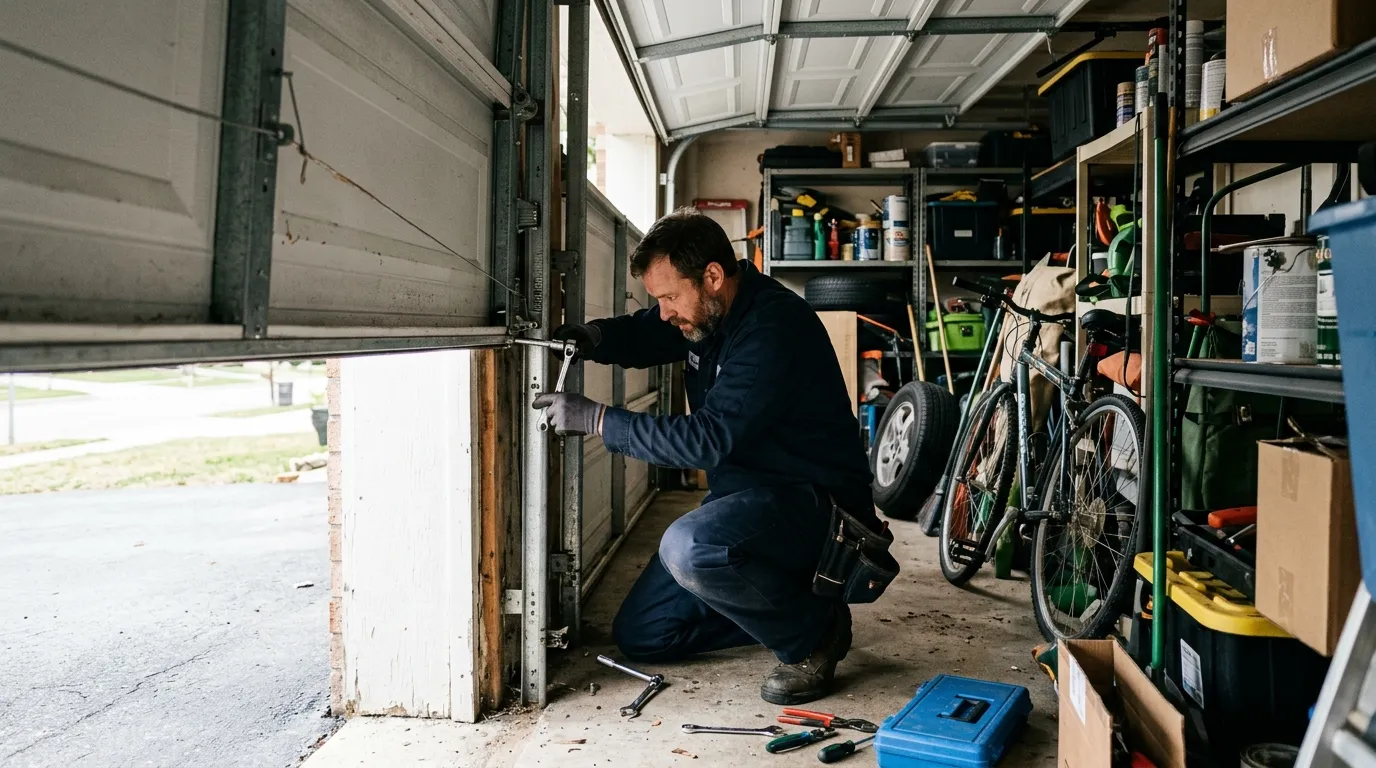
A door installed around 1985 is now pushing 40 years old, which is right in the window where torsion springs fail from fatigue and steel panels start showing rust at the bottom section, especially with the severe cold this area gets in winter. Openers from that era are usually chain-drive units on their second or third motor by now, and the original weatherstripping is long past doing its job - cold air finds its way in through cracked seals faster than most owners notice until the utility bill shows it. Because the build era here skews newer than the 1960s-70s stock common elsewhere in our coverage, you're less likely to run into the odd nonstandard track widths or side-mounted hardware that show up on the oldest houses, and more likely to be dealing with a standard torsion setup that's simply worn out from four decades of cold-weather cycling. That's usually a straightforward spring and hardware job, not a full rebuild.
No. We run out of Laurel and drive the roughly 16 miles to Derwood for scheduled jobs. We don't advertise a local depot here because we don't have one, and we'd rather be upfront about the travel than imply a presence that doesn't exist.
Yes. A door from around 1985 is usually a factory steel sectional on standard torsion hardware, which is different from the older single-panel or side-mounted setups common on 1950s-60s houses elsewhere in our area. We bring parts suited to that generation of door.
The area sits in the same severe-cold climate band as the rest of our coverage. On a door pushing 40 years old, that cold cycling is usually what finally takes out a fatigued torsion spring or brittle weatherstripping, more than any single storm.
Not always, and we'll tell you when the math doesn't favor a repair. If your door and opener are original to a mid-80s build and multiple parts are failing at once, replacement can end up cheaper over time than patching one component after another.
Call now or request a free quote - same-day service on most repairs, upfront written pricing.
