Laurel, MD · Garage Door Service
Beltsville homes mostly went up around 1976, which means steel sectional doors and extension-spring setups that don't match newer torsion hardware. We service them from Laurel, 5 miles away.
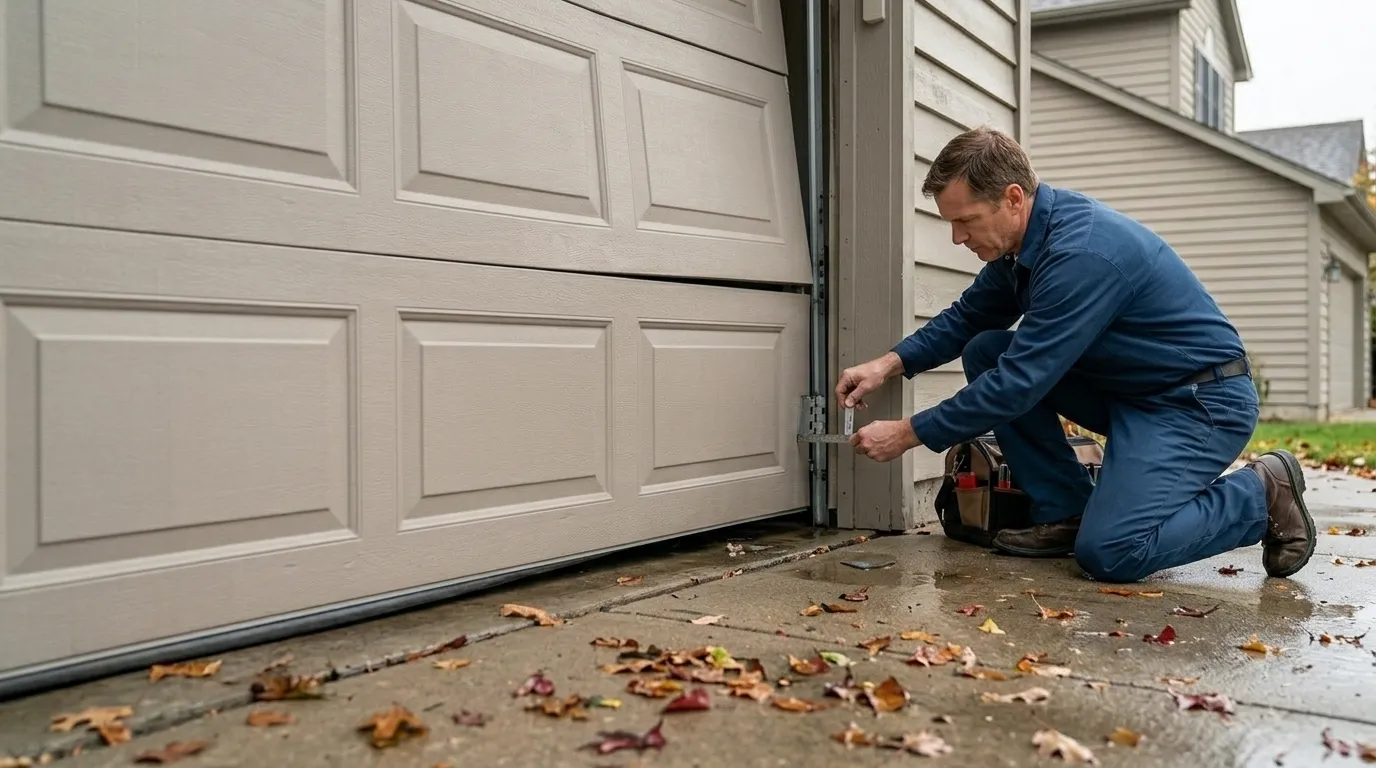
Beltsville's median year built sits at 1976, which puts most of the neighborhood squarely in the steel sectional era - the years when builders moved off wood panel doors but hadn't yet standardized on torsion springs mounted over the header. A lot of these garages still run extension springs stretched along the horizontal tracks, with a pulley-and-cable setup that was normal for a mid-70s build and is now the thing that fails first. Extension spring cable frays where it wraps the pulley, and the pulley bracket itself works loose over decades of use.
Cold, severe winters (per federal climate data for this area) add a second stress: steel contracts in the cold, and a door that's already riding slightly out of level from age tends to bind in the track on the first hard freeze of the season. That's when a spring that's been weakening quietly for years finally lets go, usually while someone's backing out for work at 6 a.m.
We're not guessing at this - a home built in 1976 in this climate band is a specific combination, and it's a different failure pattern than what we see on newer construction elsewhere in the service area.
For a door this age we stock what actually fails on it: extension springs sized for older single-car and standard double openings, replacement cable and pulley kits, and the steel roller and hinge sets that wear out on tracks from this era. We also carry torsion conversion hardware for owners who want off the extension-spring setup entirely - a common upgrade once the original system starts needing repeat repairs.
One limit worth naming: some original 1970s-era track brackets and drum assemblies are no longer manufactured. When we hit one of those, we replace the section with modern equivalent hardware rather than hunting for an exact match - the door ends up stronger, but it won't be a period-correct part.
Rollers, weatherstripping, and tightening loose hinge bolts are reasonable DIY work on a door this age. Extension springs are not - they're under load even at rest, and a spring that's been stretching and contracting through decades of cold winters can let go with enough force to do real damage. If your door is riding unevenly or the cable looks frayed near the pulley, that's a call, not a Saturday project.
We don't have a fixed number for Beltsville jobs to publish here - cost depends on whether it's a spring, a full extension-to-torsion conversion, or track and roller work, and we won't quote a price without seeing the door. What we can say is that income levels in this part of the service area (median household income around $97,115) tend to track with a preference for doing the conversion once rather than patching an aging extension system repeatedly.
Beltsville is about 5 miles from our base in Laurel, and it's one of the closer stops on our route. We don't run a branch or depot in Beltsville itself - every job here is dispatched from Laurel - but the short distance means it's an easy add to the day's schedule rather than a special trip.
A straightforward extension spring replacement is usually a same-visit job. A full torsion conversion on an older single-car door takes longer, since it involves reworking the header hardware, not just swapping springs. If we run into an obsolete bracket or drum that needs a modern equivalent part, we'll say so on site before starting rather than after.
Your home's median build year is around 1976, and extension springs mounted along the horizontal tracks were standard on doors from that period. Torsion springs over the header became common later. Extension springs work, but they wear differently and don't last as long as torsion setups.
No. We run out of Laurel, about 5 miles away, and dispatch trucks to Beltsville as part of our regular route. There's no separate branch here, so scheduling goes through the same booking as any other stop on that route.
If your door is original to a mid-1970s build and you're already looking at a spring replacement, converting to torsion hardware usually makes sense - it's a heavier-duty system and it's what most newer installs use. We'll tell you honestly if your door's condition doesn't justify the extra cost.
Call now or request a free quote - same-day service on most repairs, upfront written pricing.
