Laurel, MD · Garage Door Service
Dented or cracked garage door panels are common on Laurel's 1960s-70s housing stock. See what panel replacement involves and how to book a visit.
You back into the door, or a delivery truck clips the corner, and now one section of the door bows out or has a crack running through the ridges. Sometimes it's not a hit at all - a panel just starts to sag or rust through at the bottom where water sits against it every winter. Either way, the door usually still opens and closes, which is why people put off calling. It closes crooked, though, or the opener strains a little harder each week, because a bent panel throws off the whole curve of the door as it travels the track.
Across the service area - which runs from West Laurel and North Laurel out to Savage, Burtonsville, Fulton, and the other communities within a few miles of Laurel - a lot of houses were built between 1948 and 2014, with most of that stock going up in the 1960s and 70s. Doors on houses from that era are frequently steel sectional units that have been repainted or patched more than once, and by now the panel material itself is thin enough that a moderate impact does real damage instead of just a scuff. That's the pattern we see most: not a fresh install, but an older door taking a hit it can't shrug off anymore.
Panel replacement isn't a full door swap unless the whole unit is out of spec. Most jobs are one or two sections pulled and replaced to match the existing door - same color, same panel design where the manufacturer still stocks it, which isn't always the case on doors that are decades old. If the exact match isn't available, we'll say so up front rather than order something close and hope you don't notice.
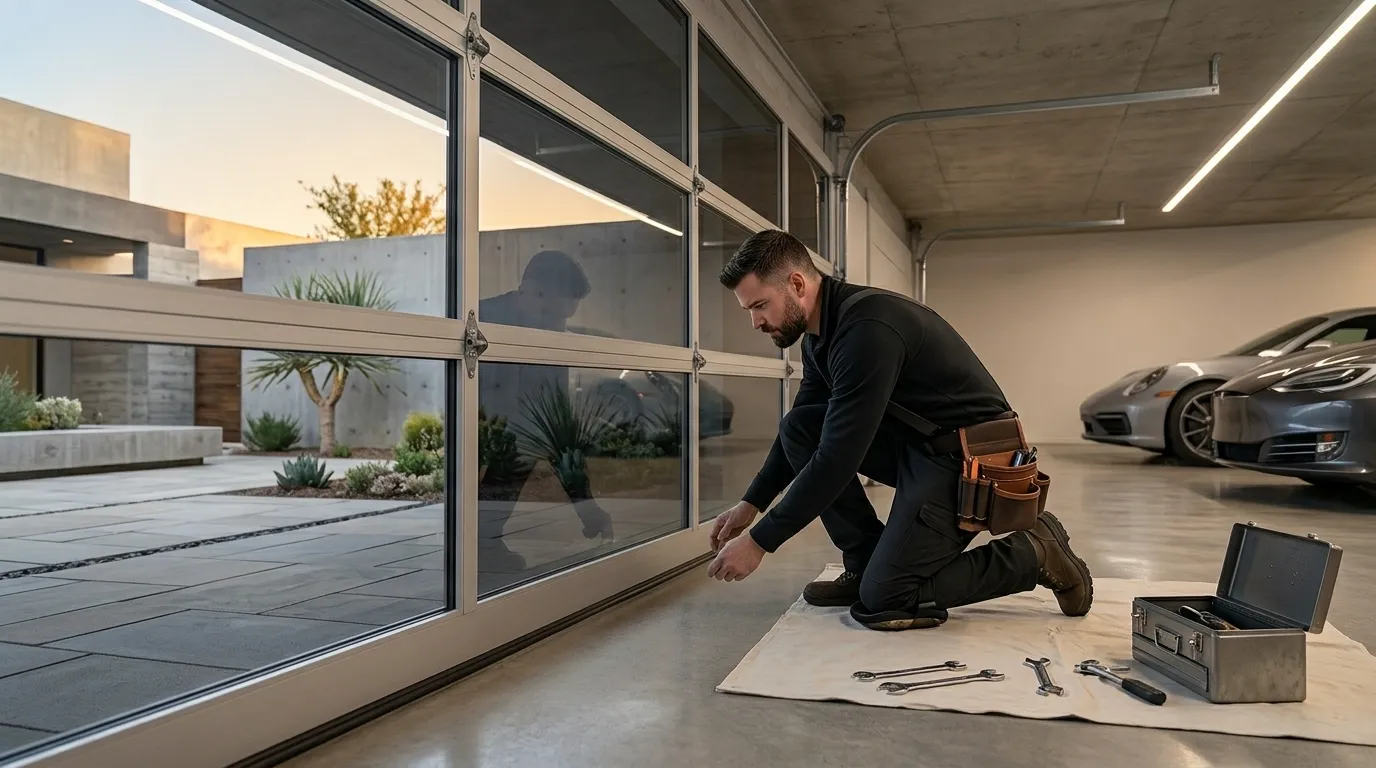
The work itself: the door comes down off the track, the damaged section unbolts from the hinges and end stiles, the new panel goes in, and everything gets re-hung and balanced against the springs. On a two-car door with a broken torsion spring hiding behind the damage - which happens more than people expect, since the impact that dents a panel often knocks the spring system out of adjustment too - that gets addressed in the same visit rather than left for a callback.
This is where the local housing stock matters again: a door built to a 1970s-era design doesn't always share hardware with what's sold today, so matching brackets and track spacing sometimes takes more time than the panel itself. We tell you that before we start, not after.
Have the door's brand or model sticker ready if you can find it - it's usually on the inside of the frame near the opener bracket - along with a rough sense of which panel is damaged (top, middle, bottom, which side). That's enough for us to bring the right stock panels or know we need to special-order.
We schedule visits across the service area covering Laurel and the surrounding communities out to roughly a ten-mile radius. If the damage is cosmetic only and the door still runs true, we'll tell you that too - sometimes a dent is a dent and doesn't need fixing to keep the door working, and we'd rather say that than sell a job you don't need.
Three things line up in this area to make panel damage more common than it might be somewhere with newer housing or a milder climate. First, the housing itself: with most of the stock dating to the 1960s and 70s and median build year around 1974, a large share of doors are original or first-generation replacements, meaning the steel is older gauge and less forgiving of impact than current doors. Second, the region sits in a cold, severe climate band, and steel panels that have been through decades of freeze-thaw cycling get brittle at the seams and rust at the bottom channel where snow melt and road salt runoff collect - a crack that starts there spreads fast once the metal's weakened. Third, sheer density: across the roughly 290,000 households and 113,000-plus owner-occupied houses in the service area, a lot of two-car garages and a lot of daily door cycles add up to more dings, more slow-motion sag, and more panels finally giving out after years of minor hits nobody bothered to fix.
Often, yes, if the door is a common brand still in production. On older doors from the 1960s-70s Laurel building boom, exact matches aren't always available, and we'll tell you that before ordering anything, along with the closest alternative.
Usually just the damaged section, unless the frame is warped or several panels are cracked. We inspect the whole door on-site and only recommend a full replacement if patching it wouldn't hold up.
Older steel panels get brittle after years of freeze-thaw cycling, especially at the bottom where snowmelt and salt runoff sit against the metal. A weak spot that's been rusting quietly can finally give out on a cold morning.
By Neighborhood
We also handle panel replacement in these Laurel-area suburbs.
Call now or request a free quote - same-day service on most repairs, upfront written pricing.
